

Understanding the Decision-Maker Behind International Patent Filings
For IP law firms, building a strong international partner network is essential. Whether you want to expand your reach, improve reciprocity, or strengthen relationships with trusted foreign associates, understanding how and why cases move between firms is critical.
But there is one challenge: In international patent filings, it is often unclear who actually decides which foreign law firm receives the work.
Is it the applicant? Or the originating IP law firm?
This distinction matters. If you want to build meaningful partnerships, you need to understand the real decision-makers behind international case flows.
This is exactly the problem the Decision-Maker Algorithm in IP Pilot was designed to solve.
IP Pilot’s proprietary Decision Maker algorithm identifies who really decides which firms receive the work.
Why Identifying the Decision-Maker Matters
When analyzing international patent filings, the raw data tells you which law firms worked on a case. However, it does not reveal who chose the foreign representative.
In practice, two different scenarios exist:
- Applicant-driven decisions: Large corporations often instruct their preferred foreign firms directly.
- Law firm-driven decisions: The originating IP firm selects a foreign partner from its own network.
Without separating these scenarios, data about case exchange between firms can be misleading.
For example, if an applicant consistently chooses the same foreign firms worldwide, it may appear that those firms collaborate frequently with the original firm. In reality, the originating firm may have had no influence over the selection at all.
To understand a firm’s genuine international partner strategy, these cases need to be filtered out.
The IP Pilot Decision-Maker Algorithm
IP Pilot addresses this challenge with a proprietary algorithm that analyzes patterns in global filing data.
The algorithm predicts who most likely made the decision about the foreign representative in a particular case exchange. This allows users to:
- Filter out cases where the applicant controlled the choice
- Identify situations where the originating IP law firm selected the partner
- Reveal a firm’s true international collaboration network
Because decision-maker information is not available in raw patent data, this algorithm provides unique insight into international filing strategies.
The result is a much clearer picture of how IP firms actually work together across jurisdictions.
The application of the decision-maker algorithm explained: Understanding Filing Behavior with Qualcomm
To illustrate how the algorithm works, let’s look at a real-world example.
Take Qualcomm, one of the world’s largest patent filers. Between 2010 and 2020 alone, the company filed over 167,000 patent applications, including more than 16,000 filings in Europe.
When analyzing the case flow for Qualcomm’s European filings, multiple U.S. firms appear to work with the same European patent firms.
At first glance, this might suggest that these American firms prefer the same partners.
However, when the decision-maker algorithm analyzes the patterns, a different story emerges.
The data indicates that Qualcomm itself is the decision-maker behind these referrals. In other words, the applicant dictates which European representatives should receive the cases.
This insight fundamentally changes how the case flow should be interpreted.
Instead of assuming collaboration between the firms, we see that the client controls the partner selection.

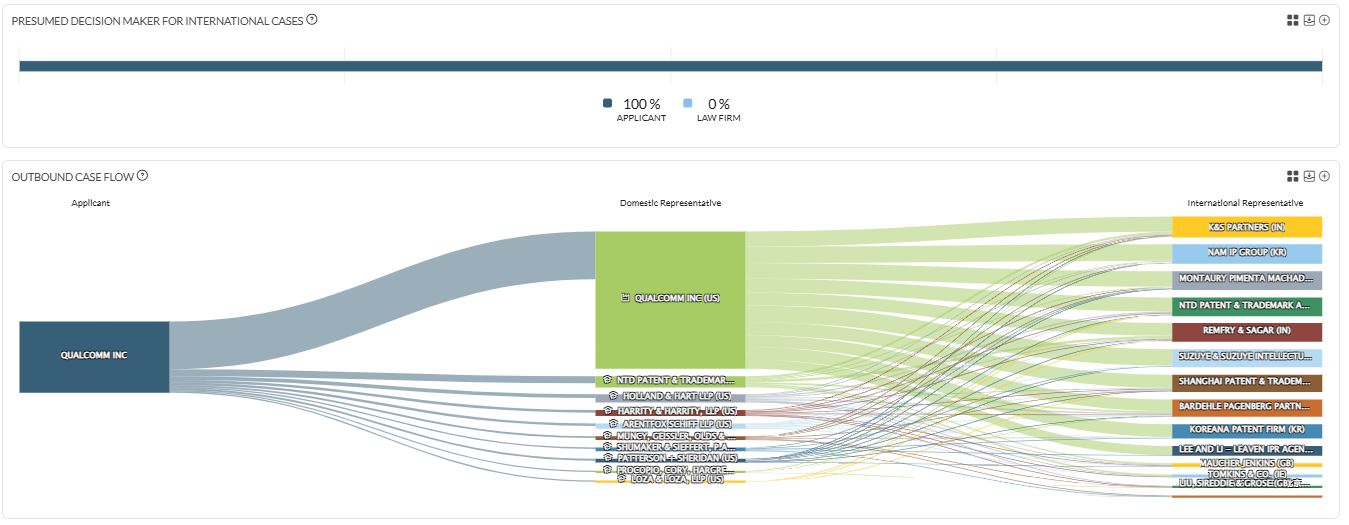
The picture shows the pattern and visualizes how the Patent-Pilot algorithm can understand whether Qualcomm or the US IP law firms are in charge of the case flow decisions.
Indeed, a high number of American firms simultaneously appear to have connections to the same European patent firms. For example, HOLLAND & HART LLP, ARENTFOX SCHIFF LLP, and SHUMAKER & SIEFFERT, P.A., all seem to prefer to work with the same European firms. This includes German BARDEHLE PAGENBERG PARTNERSCHAFT MBB, British MAUCHER JENKINS and REDDIE & GROSE.
In this scenario, the probability is extremely high that Qualcomm instructs American IP law firms to send cases to its preferred partner in Europe (or directly sends the work to the EP representatives).
The Patent-Pilot algorithm predicts that in 100% of cases, Qualcomm is a decision-maker behind the case flow. Indeed, if American IP law firms were not bound by the applicant in their choice of the European partners, they would not be prone to choose the same firms as other representatives of Qualcomm’s priority filings. They would rather send the cases to the firms of their own partner network.
All in all, irrespective of the IP law firm’s business development strategy and approach, it is always important to clearly understand how its potential clients and partners behave. To see the true international filing strategy of the potential partner, it is, therefore, crucial to discern the decision-maker behind the case flow. Decision-maker information is not available anywhere in the patent raw data. In this regard, Patent-Pilot’s algorithm and decision-maker feature are of a high value for the IP law firms as it allows to see the behavior and find the right partner IP law firms.
Removing the “Noise” in Case Exchange Data
By identifying who made the referral decision, IP Pilot helps remove misleading signals from filing data.
Once applicant-controlled cases are filtered out, firms can clearly see:
- Which partners other firms actually choose themselves
- The real exchange relationships between firms
- Opportunities for reciprocity and collaboration
This allows business development teams to focus on genuine partnership opportunities instead of patterns created by client preferences.
A Powerful Tool for IP Law Firm Business Development
For IP law firms looking to grow internationally, understanding partner behavior is key.
With the Decision-Maker feature, IP Pilot enables firms to:
- Identify true international partner networks
- Understand case exchange strategies of potential partners
- Estimate the volume of work a firm can freely allocate
- Discover new collaboration opportunities
By transforming complex patent filing data into actionable insights, IP Pilot helps firms make smarter decisions about where to invest their business development efforts.

See the Decision-Maker Feature in Action
IP Pilot provides access to detailed analytics on over 35,000 IP law firms and millions of patent and trademark filings worldwide.
With interactive visual reports and advanced filtering tools, you can analyze filing strategies, identify decision-makers, and uncover valuable partnership opportunities.
Start exploring IP Pilot today and discover the real drivers behind international patent case flows.