

Published, January 2023
IP Business Development Strategy Using Big Data
Interpersonal relationships have always been and will always be crucial for the success of IP law firms’ business development. These relationships are built on trust, reputation and/or legacy. Without proper maintenance, however, they can be arbitrary and transient.
Data has a way to minimize or mitigate this. This is especially so as we enter into the post-Covid era when people and businesses alike are already accustomed to efficiencies and new ways of working (digitally). Data allows law firms and attorneys to make strategic and informed decisions such as whom to work with and why. It also justifies resources to be allocated to specific marketing and business development initiatives that will bring about the best returns on investment.
In this 4-part series, we dive into how to use big data analytics to (1) create a business development strategy for a law firm, (2) identify the right targets which are aligned to this strategy, (3) prepare to approach and prospect targets, and (4) successfully pitch at meetings.
Let’s start first with creating an IP business development strategy.
Evaluate Your Internal Capabilities
There are many ways to do this, such as the SWOT analysis, Business Model Canvas, etc. Alongside, you want to collect your firm’s performance metrics such as financial health of the business, revenue contribution from the various business units e.g. Patents/Trademarks/EP Validations, as well as consolidate the profiles of your client portfolio, existing initiatives and channels for business development, technical capabilities of your attorneys and broader IP team, etc. It may make sense to collect this information over the past 3 to 5 years, to observe changes and trends.
Regardless, the idea is not to jump to any conclusions about any of these KPIs but rather, to be able to holistically understand your current state of the business development approach.
Assess External Influences
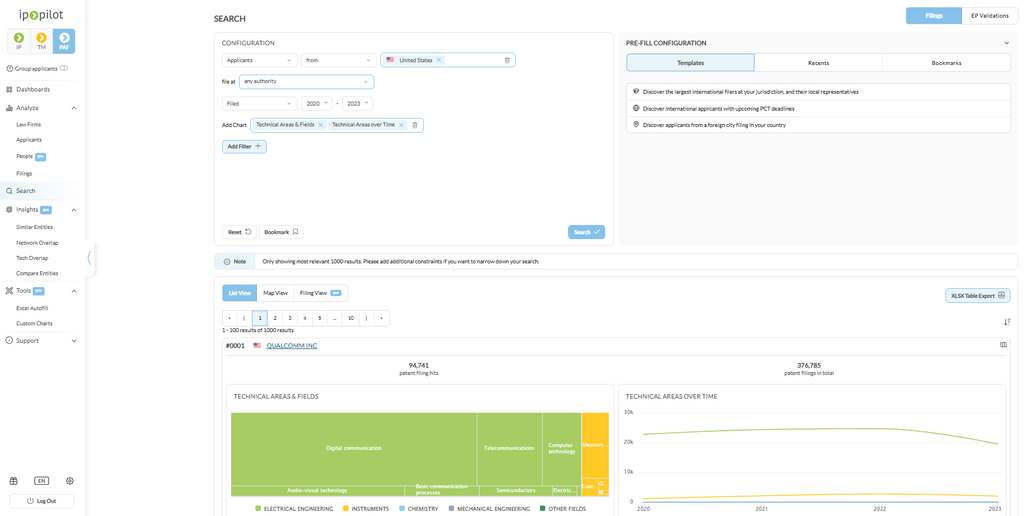
Alongside the internal review, look outward at macroeconomic shifts, emerging technology, and the competitive landscape. IP Pilot’s data visualizations can help identify the innovators leading a given technical field, and surface how competitors are positioned — from their client portfolios and filing volumes to their international case-exchange activity and partner networks. Knowing where the competition stands is what makes it possible to differentiate a firm’s own offer.
- Client portfolio: which clients a competitor already represents
- Patent & trademark practice volume: how large and active their filing practice is
- International case exchange: how much work moves across borders, and in which direction
- Partner network: who they already work with, and where those relationships are concentrated
Set IP Business Development Goals
With internal strengths and gaps mapped against the external landscape, bring the team together to set goals for the year ahead (or whatever period suits the firm). Frameworks such as SMART or OKRs help keep those goals measurable and the team accountable for them.
- New clients vs. referrals: should growth come mainly from direct wins, or from partner introductions?
- Reciprocity: are existing partner firms sending back a fair volume of work?
- Cross-sell potential: can existing clients be offered additional services they aren’t using yet?
Continue the Series
This article is part 1 of a 4-part series on data-driven IP business development. The rest of the series:
- 2. Targeting IP Clients and Law Firms for Business Development
- 3. Prepare for Business Meetings with IP Big Data
- 4. Executing Meetings Successfully Using IP Big Data
Ready to Take Action
With a clearly defined IP business development strategy in place, the firm is ready to turn insight into targeted outreach and stronger partnerships.
