
IP Pilot turns to AI: introducing AutoPilot
From a single question to a growth strategy.
AutoPilot, AI that advances IP law firms.
IP Pilot maps who works with whom across global IP: who sends work where, and whether it comes back. We spent years building that map, resolving 120M+ patent and 190M+ trademark records from 180+ jurisdictions down to the individual attorney. Then we made it readable.
But much of the work stayed with you. Which search to run. Which filters to set. What to export. What it all means.
That’s when we realized: holding the data is not the same as having the insight. And it is a long way from a structured action plan for growth.
Ask in plain language and it answers from the data. Go deep and it builds a strategic action plan for your firm’s growth. Connect it through MCP and the same intelligence runs inside your firm’s own AI tools.
From market intelligence to strategy: IP Pilot is now the tool you steer your firm by.
Three ways AutoPilot works for your firm.
AutoPilot chat Ask
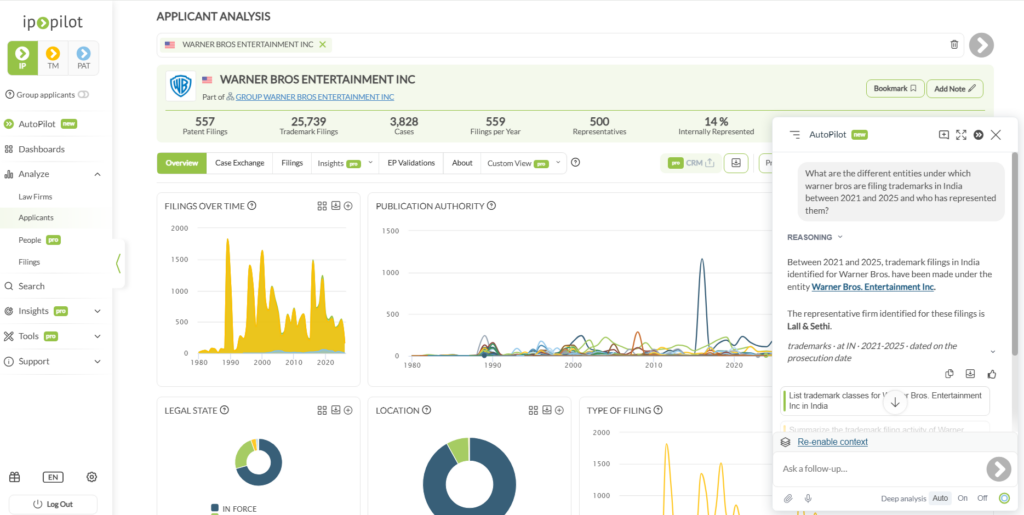
No searches to build, no filters to set. Ask in plain language, in its own chat or on any page of the app, and get the answer, and what it means for your firm, in seconds.
Deep analysis Steer
Go from what happened to what to do next. AutoPilot works through your network and builds a strategic action plan: which relationships to defend, which to win, where reciprocity slips.
MCP Connector Connect
IP Pilot’s relationship data inside your firm’s own AI tools, next to your matters and clients. Answer questions neither side can answer alone. Your client data never leaves your side.
AutoPilot is live
Ask in plain language.
Get the legwork done.
The layer that turns everything IP Pilot already maps into something you can actually ask.
AutoPilot chat Ask
Answers from the data, not from memory.
AutoPilot is an AI agent that lives inside the IP Pilot app and is built on IP Pilot’s own data. It doesn’t just retrieve information. It works out how to answer your question, gathers the facts and explains them. The whole interaction is AI-driven: from understanding what you asked, to deciding which parts of the dataset, feature descriptions or Help Center resources answer it, to putting the answer together and explaining what it means. Every partner gets the full depth of IP Pilot, not just the power users.
The model does not know the IP market. Our data does. The model’s job is to ask the data the right questions.
That’s the difference from a general-purpose AI. A chatbot answers from what it absorbed during training, and when it doesn’t know, it guesses convincingly. AutoPilot answers only from resolved filings it has just retrieved, and it shows you where each figure comes from.
Two ways to use it
Dedicated chat: for longer analysis, with the interface everyone knows.
Contextual Panel: built into the app and aware of where you are. Partway through a profile, it reads the analysis you’ve built and suggests the next step.
How it works
You ask.
Ask a question in plain language, the way you would ask a colleague.
The model plans.
A large language model (LLM) works out what the question needs and in which order.
Our tools fetch the facts.
The model doesn’t answer from memory. It calls IP Pilot’s own data services, which we call tools: for example, to look up a firm, pull the same figures the charts in the app show, or list the filings behind a number.
AutoPilot writes the answer.
The answer is written only from what those tools returned. Every figure can be traced to our data, and every firm and attorney is linked to its page in the app, so you can check any claim with one click.
Example prompts
Which foreign law firms sent us at least 10 patent cases per year in 2021–2022 but fewer in 2024–2025?
Which clients of [foreign partner firm] filed patents in [jurisdiction] in 2023–2025 through a local firm other than us?
Which foreign applicants in [technical field] filed in [jurisdiction] in 2024–2025 and used more than one local law firm?
Deep analysis Steer
Describing the data is the easy part. What customers ask for most is the next step.
In deep analysis mode, AutoPilot moves from answering to advising. It works through your network over several steps and turns the result into a structured action plan for growth. The questions it is built for are the ones partners actually bring to the table:
Which relationships are drifting, and need attention now?
Which firm is worth approaching to improve reciprocity and win inbound work, and on what basis?
Any general model will give you an answer to those questions, and it will sound plausible. What it cannot know is what important means for your firm: which relationship is worth saving, what healthy reciprocity looks like in your jurisdiction and at your size, and which shift in a filing pattern is a real signal and which is noise.
That judgment does not come from the model. It comes from the layers we built around it.
1. Strategy layer
AutoPilot includes an IP law firm strategy and go-to-market framework written by our team. It works like an experienced BD consultant’s playbook. It tells AutoPilot which questions to ask of the data, how to read the results for your kind of firm, and what to recommend.
The framework follows the way a firm actually plans its strategy, in five parts:
Diagnose
Decide
Grow
Protect
Execute
The LLM brings the reasoning. The framework brings the method. The data brings the facts. As a result, the advice you get is grounded in resolved filings, follows a clear strategic logic, and always comes with the reasoning behind it.
2. Help Center layer
Answers how-to questions about IP Pilot from our own feature descriptions and Help Center, and provides a concrete solution right there in the chat, and links you to relevant articles for further reading. You get help in the moment, without leaving the app or opening a support ticket.
3. More to come
New layers are in development.
MCP Connector Connect
The market and your firm, in one answer.
IP Pilot’s data tells you about the market. Your own systems know your matters, your clients and your history with them. The questions worth asking usually need both:
“Which of our highest-billing clients are filing more in our jurisdiction, but through other firms, not us?”
Neither side can answer that alone. Until now, answering it meant exporting from one system, exporting from the other and matching them up by hand in a spreadsheet.
MCP removes that step. The Model Context Protocol (MCP) is an open standard that lets AI assistants connect securely to IP Pilot data sources. If your firm uses an AI assistant that supports MCP (Claude, for example), you add IP Pilot to it as a connector. From then on, the assistant can query AutoPilot directly, through a defined set of tools, the same way it reads your own records. A partner asks the question in plain language instead of building a CSV.
Your side
Your systems
Matters, clients, billing history. They stay where they are.
The channel
Your AI assistant
Combines both sides into one answer. It runs on your side, not ours.
IP Pilot
AutoPilot
Available through a set of queries the assistant can run.
Not an export button. A real integration.
What it changes for your firm
Access follows the license
Why you need AI to survive, and IP Pilot to win.
Clients already press for lower fees because they know AI does part of the work, while the cost of adopting that AI climbs. Soon every serious firm will run the same general-purpose tools, and AI becomes the price of entry: you need it to survive, not to win.
What decides who wins is the ability to generate work, and that lives in the network.
What AI makes standard
Drafting and prosecution
Faster, cheaper. The same tools at every firm.
What general-purpose AI cannot reach
The network
Who trusts you with their foreign filings. Whose work comes back. Which relationships are quietly thinning.
It took years to build, it is not written down anywhere in usable form, and no model can produce it on request. That is the part we measure, and the AI we built sits on top of it to provide your firm with the advantage.
Try AutoPilot yourself.
Log in and ask about your own firm: who sends you work, where reciprocity runs one way, and which relationships are cooling.
Have questions? Ask our support team at support@ip-pilot.com
