
A law firm profile is where you build a detailed picture of one firm: its filing strategy, the clients it represents, the international cases it exchanges with other firms, and the technical areas it covers.
Analyze or Search? Use Analyze when you already know the firm you want. Use Search when your starting point is broader, such as finding which firms in a country file most in your jurisdiction, or identifying firms that match criteria you set. A common sequence is to build a shortlist in Search, then open any result here.
The year range, the year type and the filters sit in the top-right toolbar and change every figure on the page. Navigating the App covers them, including what each year type means and when to override it.
1. Find and open a profile #
- 1Open Law FirmsSelect Law Firms under Analyze in the left navigation pane.
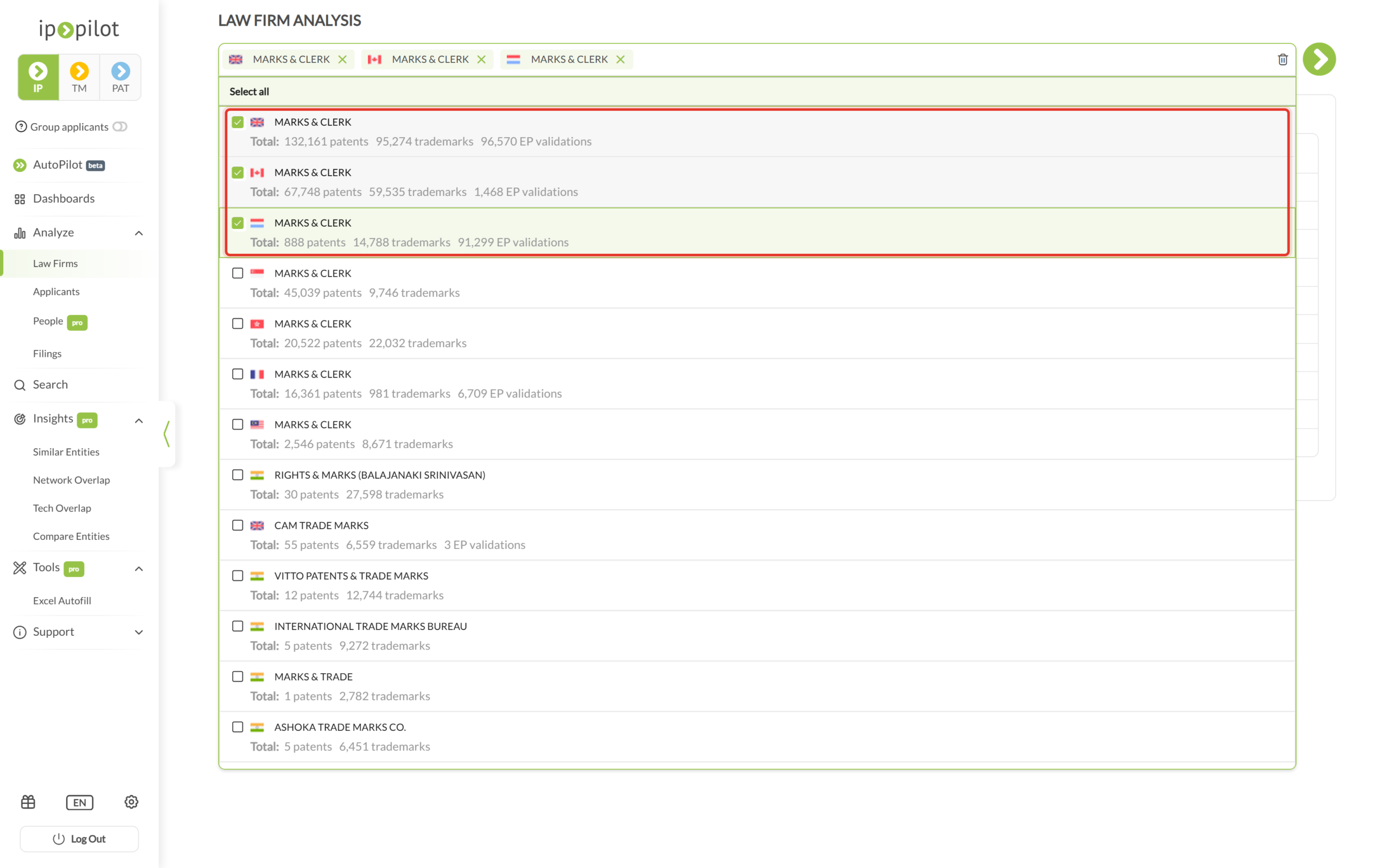
- 2Type a nameType the firm name into the search bar at the top. A dropdown appears as you type, showing each match with its country flag and a count of patents, trademarks and EP validations. Use those details to tell apart firms with similar names across countries.
- 3Select the firm you wantTo analyze several entities together, such as the UK, Canadian and Dutch offices of one firm, select each one.
- 4Open the profileClick the arrow on the right.
When you open more than one entity, the profile header shows the primary name followed by +2, +3 and so on, indicating how many others are included.
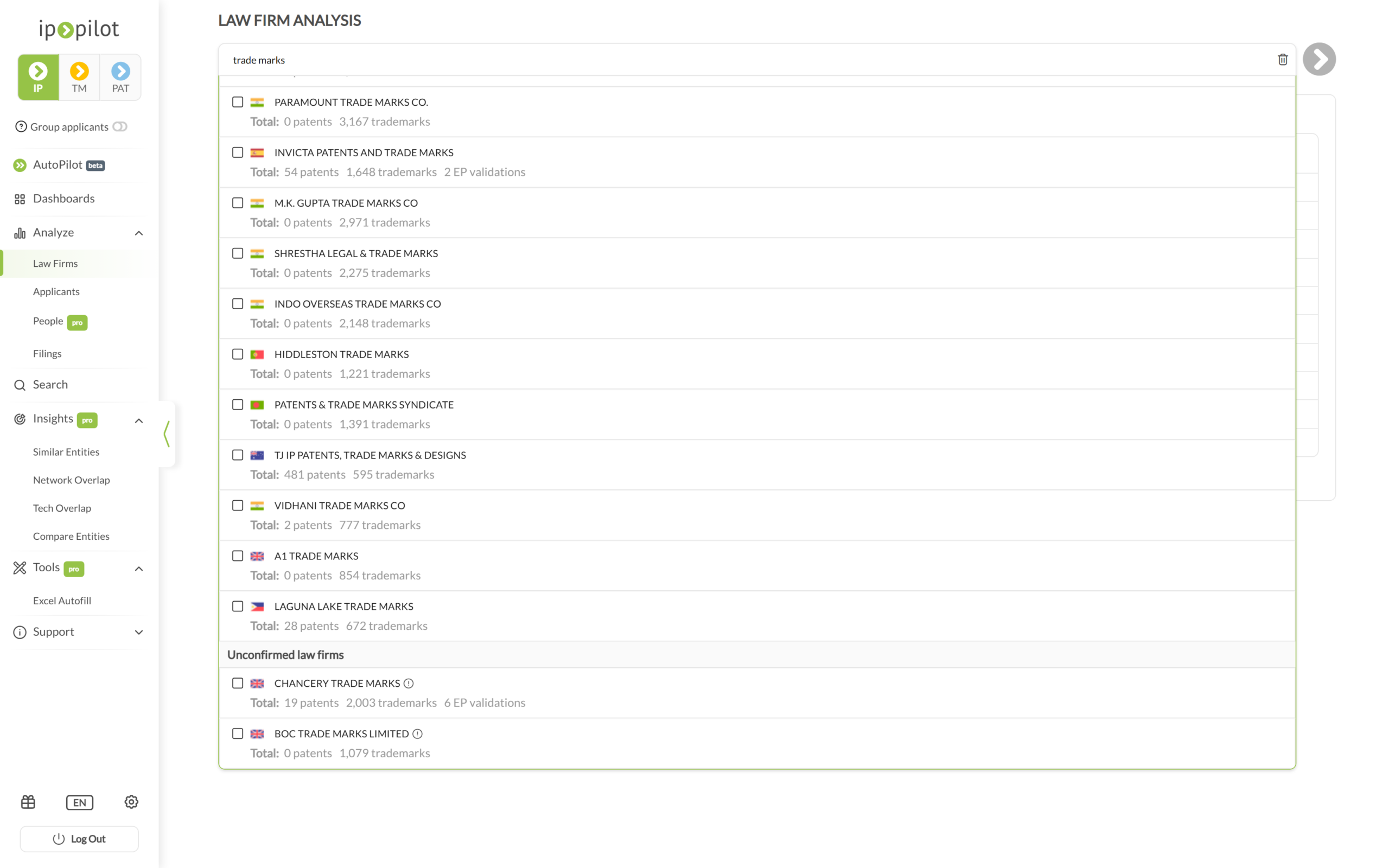
Can’t find a firm? Scroll below the confirmed results to the Unconfirmed law firms list, marked with an information circle. These are usually boutique or newer firms, or names found on filing records that IP Pilot could not confidently link to a single entity. IP Pilot found filings under that name but cannot confirm they all belong to the same firm, so use these results with caution.
Getting back to a profile. On the Analyze landing page, the Profile Bookmarks panel on the left holds profiles and charts you have saved, and the Recent Searches panel on the right lists the profiles you opened most recently. Click any entry to reopen it.
A combined profile treats the selected firms as a single entity. To keep them apart and read them column by column, use Compare Entities. For the same data points across a long list of firms, use Excel Autofill.
2. Read the KPI bar #
The KPI bar at the top of the profile gives the headline figures for the firm, or for the combined entities you are viewing: Patent Filings, Trademark Filings, Cases, Filings per Year, Clients, the share of work handled via an international route, and the ratio of sent to received cases. EP Validations is included where that applies.
How many figures appear depends on whether you are in IP, TM or PAT, and on whether your subscription includes EP Validations.
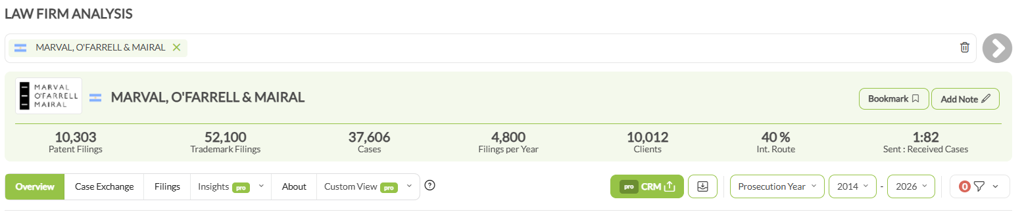
The bar also carries the tools you use throughout the profile:
- Bookmark saves the profile to your Profile Bookmarks panel for next time.
- Add Note attaches a text note to the profile, shown every time you return.
- The top-right toolbar stays on every tab and holds Year Type, the year range, Export Profile and the CRM push.
Filings and cases are not the same count. A filing is any single application sent to a publication authority. A case groups filings from the same patent family handled by the same agent, so one underlying application is not counted several times when it appears in several countries. Overview reports filings and Case Exchange reports cases, so the two totals are not expected to agree. For trademarks, IP Pilot builds families from verbal elements, timing and filing patterns across regions.
In practice #
Three of the most frequent jobs on a law firm profile, start to finish.
Assess reciprocity with a partner before a conference #
- Open the firm’s profile and go to the Case Exchange tab.
- In the Important Partners chart, find your firm.
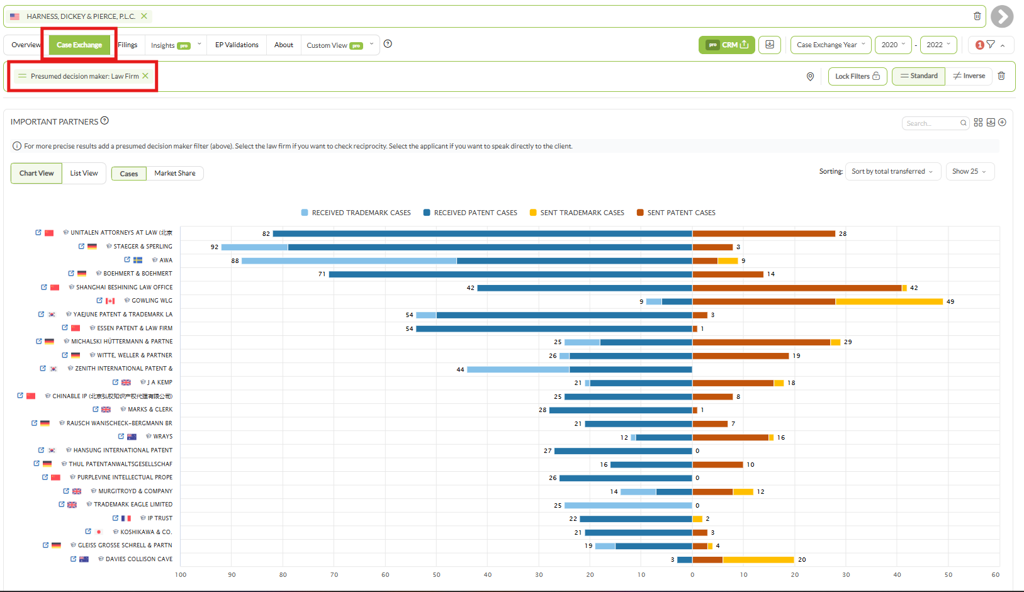
- Set the Presumed Decision Maker filter to Law Firm. This shows only cases where a firm decision drove the referral.
- Compare the sent and received volumes to judge whether the relationship is balanced, and genuinely firm-driven rather than client-directed.
Find opportunities in your client base #
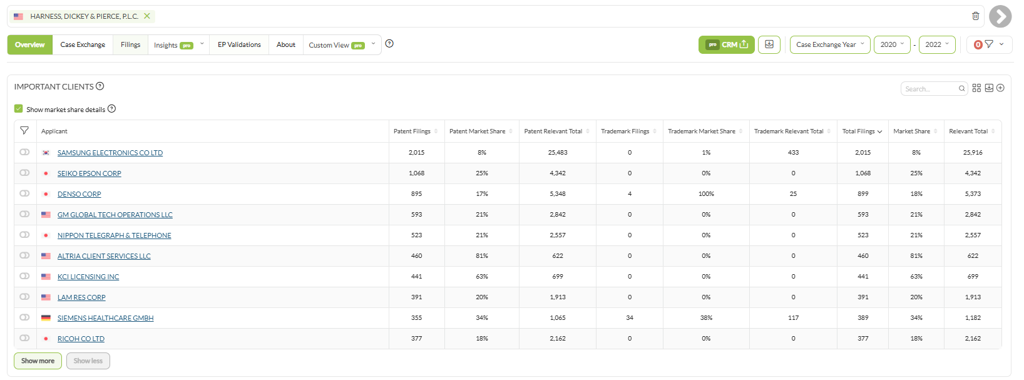
- Go to the Overview tab and open the Important Clients table.
- Tick Show market share details.
- Look for clients where your firm’s share is lower than expected.
- Click a client’s name to open their applicant profile and see what else they are filing in your jurisdictions, and which other firms handle it.
Prepare for a one-on-one with a specific attorney #
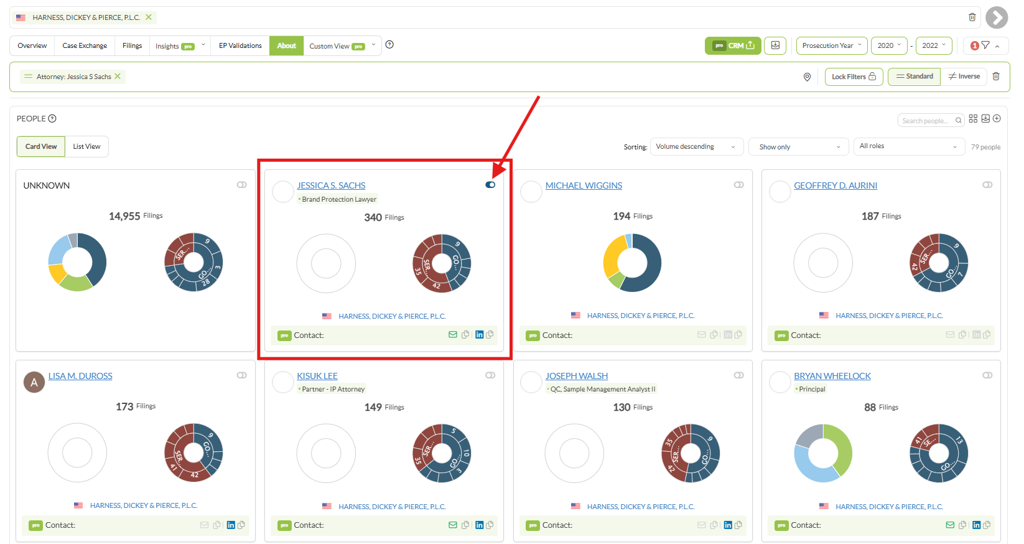
- Go to the About tab and open the People section.
- Toggle on the attorney’s name. The whole profile now filters to their activity.
- Switch to Overview to see the clients they personally represent, then to Filings for their individual cases.
- Click their name to open their standalone profile for contact details and full career history.
Every profile is organized into tabs: Overview, Case Exchange, Filings and About. The EP Validations tab appears only for firms in EPO member countries. Insights and Custom View are on Pro.
3. Overview tab #
How to use it
- Read Filings Over Time at the top to see how volumes have moved across your selected period, and Publication Authority to see where filings are registered.
- Scroll to the client section to see who the firm works for.
- To reveal market share, tick Show market share details above the Important Clients table. The percentage shows how much of a client’s total activity in a given authority this firm handles. A low share flags untapped potential, because the client is placing work elsewhere.
- Click any client’s name in Important Clients to jump straight to their applicant profile.
- To narrow the picture, click any chart segment, bar or slice. Every chart on the tab is an active filter, and the others update to match. Filters from several charts stack. To keep the same filters when you switch to another firm, click Lock Filters. This is useful for comparing firms on the same criteria.

Reference: what the charts tell you
| Section | Charts |
|---|---|
| Activity | Filings Over Time; Publication Authority; Legal State; Location; Type of Filing; Lifecycle; Grant Status; Filing Route; Applicant Origin |
| Clients | Client’s Country; Important Clients over Time; Important Clients |
| Patents | IPC Sections & Symbols; Technical Areas & Fields; Technical Areas over Time |
| Trademarks | Trademark Category; Nice Classes; Verbal Elements |
4. Case Exchange tab #
How the tab is laid out
- The left column covers received cases: work other firms have sent to this one.
- The right column covers sent cases: work this firm has referred out.
- Both show the countries and jurisdictions involved, how patterns have changed over time, and the Presumed Decision Maker chart.
- The Inbound Case Flow and Outbound Case Flow diagrams trace each case from applicant, to domestic representative, to international representative, so you can see where work originates and where it goes.
How to use the Important Partners chart
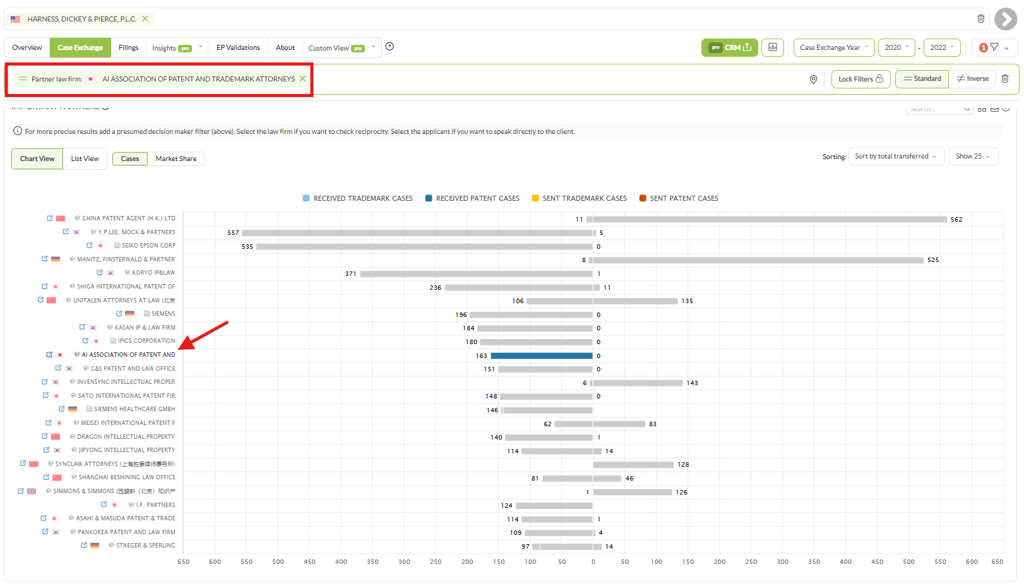
At the bottom of the tab, Important Partners is the full referral partner list. Read it as a dual-direction bar chart showing received and sent volumes, for both patents and trademarks. A sent bar of 562 against a received bar of 11 means the firm you are viewing sent 562 patent cases to that partner and received 11 back.

Switch between Chart View and List View, and between Cases and Market Share. The Show control sets how many partners are listed, up to 100.
Set the Presumed Decision Maker filter above the chart:
- Law Firm: only cases the firm directed. Use this for a true read on bilateral, firm-driven reciprocity.
- Applicant: cases the client drove. Use this when you plan to approach the client directly rather than the referring firm.
Click a partner’s name to filter to that firm, then switch to Overview to see shared clients and technical areas.

Why this matters. If a firm sends you many cases but most are applicant-directed, the relationship may be weaker than the volumes suggest. A law-firm-directed case means the partner actively chose to send work to you.
Data note: Trademark case exchange data may be incomplete because of missing data connections at family level. Keep that in mind when reading trademark referral volumes.
5. Filings tab #
How to use it
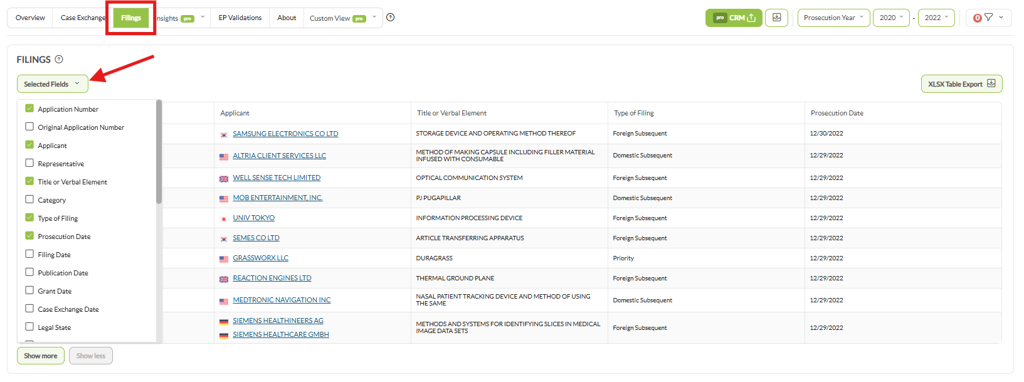
- Read the table. By default it shows Application Number, Applicant, Title or Verbal Element, Type of Filing and Prosecution Date.
- To add columns, open Selected Fields and choose from Original Application Number, Representative, Category, Filing Date, Publication Date, Grant Date, Case Exchange Date and Legal State.
- Click any application number to open its full bibliographic data, including legal status and filing history.
- To export, click XLSX Table Export at the top right. The file reflects your current columns and active filters.
Note: Patent data comes from public databases, so filings that are not yet published do not appear.
6. EP Validations tab #
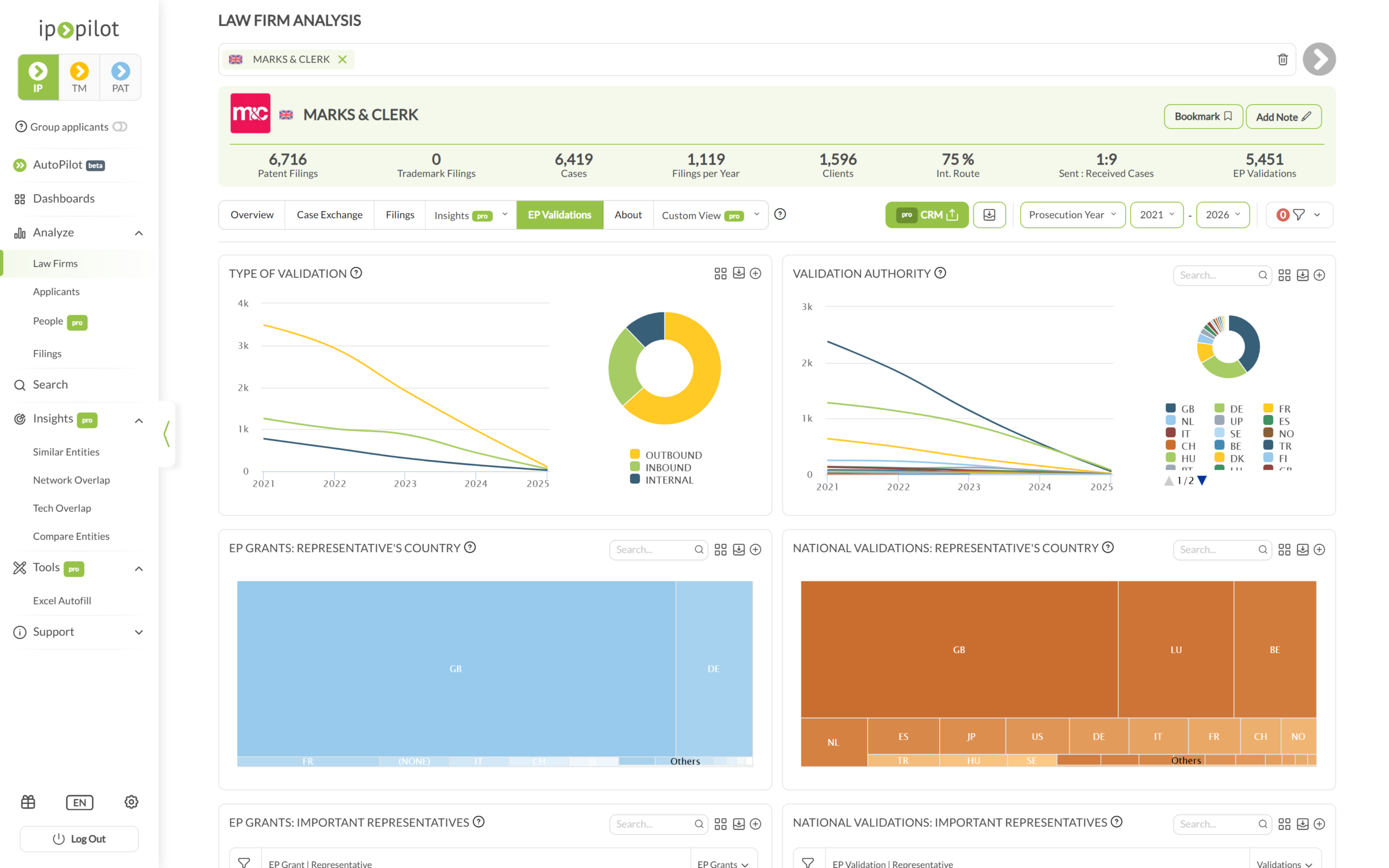
Three activity types
- Inbound: the firm handled the national validation; a different firm held the EP grant.
- Outbound: the firm held the EP grant; a different firm handled the national validation.
- Internal: the same firm did both.
How the tab is laid out
The left column covers EP Grants, the right National Validations. Each shows the top counterpart firms, a treemap of representative countries, a ranked partner table, and trend lines showing whether relationships are growing or shrinking.
Presumed Service Provider Involved, unique to this tab, shows whether an annuity or validation service was involved rather than a law firm.
Latest Validations at the bottom lists individual recent transactions. Click an application number for its bibliographic data.
7. About tab #
Note: the Contact and Offices panels are on Pro.
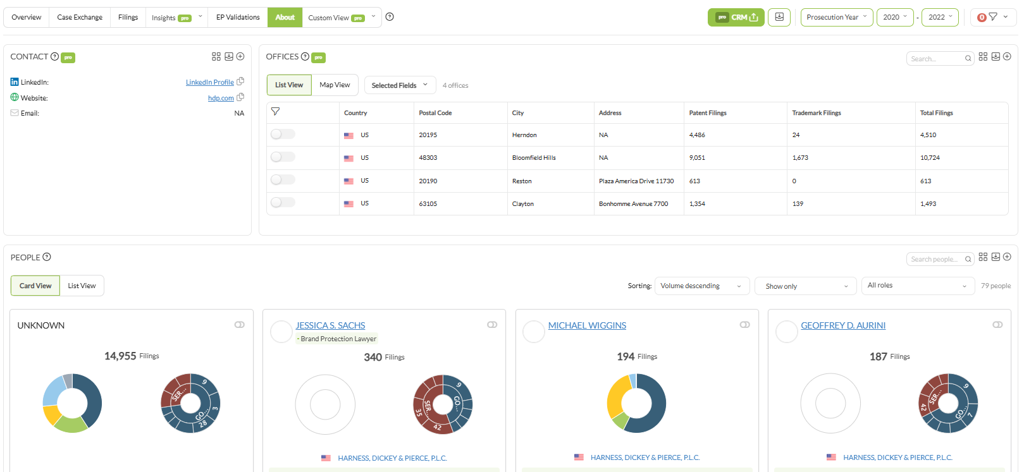
- Contact: LinkedIn, website and email for each entity in the profile.
- Offices: physical locations, as a table and a Map View. Each office row has a toggle that filters the whole profile to that office’s activity.
- People: a directory of the practitioners on the firm’s filings. Browse in Card View or List View, sort by filing volume, and filter by role. Toggle a name on to filter the whole profile to their activity, then switch to Overview for their clients or Filings for their individual cases. Click the name to open their standalone profile, which carries contact details, LinkedIn, every firm they have worked at, and their filings per firm.
8. Exporting data #
Three ways to get information out.
- Export the profile as a PDF. Click the Export Profile icon in the toolbar, beside the Year Type selector. Choose which sections to include, set the Date Type and pick a paper size, then click Preview PDF. Despite the label, that button starts the real generation.
- Export a table as XLSX. On the Filings tab, click XLSX Table Export at the top right. The file reflects your current column selection and active filters.
- Export a single chart. Hover the chart and click the download icon in its top-right corner, then choose a format. Most charts offer JPG, PDF, XLSX and SVG; some offer fewer.
Exports covers every route and the options each one offers.
Good to know #
- Every KPI and chart reflects the active time period, Year Type and filters. If a number looks wrong, check those three before drawing conclusions.
- Recommended Year Types: Prosecution Year for Overview, Case Exchange Year for Case Exchange, Grant Year for EP Validations.
- Chart filters on Overview and Case Exchange stack, and persist across profiles with Lock Filters, which lets you compare firms on the same criteria without reapplying settings.
- Bookmarks and notes are per profile and private to your account.
- (NONE) appears as a category in several charts, including Legal State, Lifecycle, Grant Status and the People directory. It covers the filings where that particular property was empty in the record. On People it is often the largest entry, because many filings name only the firm.
- For patents, a low figure in the current year usually reflects publication delay rather than a real decline.
Frequently Asked Questions #
Frequently Asked Questions #
Law Firms #
What is the difference between a “representative”, “attorney”, “law firm” and “agent”?
By representative we mean any person or entity named as an agent on a patent or trademark application. In some jurisdictions they may instead be listed as a correspondent, though in most cases this is still the representative.
Representatives are usually law firms, or attorneys and lawyers employed by IP law firms. Some countries distinguish between an agent and an attorney; in others, general lawyers may also represent clients before IP offices. A representative is not always an external firm: corporates employ in-house attorneys who represent applications internally.
Because of these variations, “representative” is the most accurate umbrella term. To keep the wording simple we say “law firm” wherever that is correct, and “representative” wherever “law firm” would be inaccurate or too narrow.
Can I analyze several law firms at the same time?
Yes. Select as many firms as you need in the name search before loading the profile, and IP Pilot returns a single combined profile covering all of them.
If you would rather see firms side by side instead of combined into one profile, use Compare Entities.
Why do the filing numbers in IP Pilot differ from our internal database?
IP Pilot can only show information that is publicly available. Your internal database may include filings that were never published, or that have not been published yet.
The other common cause is comparing different time windows. Check that the type of date matches on both sides. Prosecution, filing, publication and grant dates are not interchangeable, and the difference can be substantial.
How do you define a case?
A case is all applications within the same patent or trademark family represented by the same agent. It is not the same as an application.
For example: a US agent files a US application and then a PCT application, and a European firm takes over the EP regional phase filing. Counting every application in the family would suggest the European representative received two applications, when it received one case.
This is why every statistic about case exchange is based on cases rather than applications. Note also that only cases which were actually exchanged are counted. A family containing just a priority filing that was never internationalized does not appear in case exchange, because no exchange took place.
Why do the figures differ between the Overview and Case Exchange tabs?
Overview reports filings. Case Exchange reports cases.
A case is all applications within the same patent or trademark family represented by the same agent, so one case can cover several filings. Case Exchange also counts only cases that were actually exchanged, so families that never left their priority jurisdiction are excluded.
Because of this, the totals in the two tabs are not expected to match.
How is the “Sent : Received Cases” ratio calculated?
It is the ratio of cases the firm sent to cases it received, calculated over the year range, the year type and the filters you currently have applied. Change any of those and the ratio changes with them, exactly as the rest of the KPI bar does.
It tells you whether a firm is inbound or outbound oriented within the scope you have set. It is not a lifetime or worldwide figure, so the same firm read with a different year range or a different filter will legitimately show a different ratio.
Can I export or print a law firm profile?
Yes. An individual chart is exported with the download icon next to its title. A table is exported with its own XLSX Table Export button above it, not with that icon.
For the whole profile, use the Export Profile icon below the tabs and choose which charts and tables to include.
Export is not available on trial access. If you believe you should have it, contact support@ip-pilot.com.
How can I see a firm’s important partners from one specific jurisdiction?
Select the jurisdiction you are interested in on the Sending Representative’s Country or Receiving Representative’s Country chart. The Important Partners chart updates to show only partners from that jurisdiction.
Can I see important partners for patent and trademark cases in the same chart?
Yes. Set the side-menu toggle to IP and the chart includes the most important partners for both patent and trademark cases, with volumes shown as separately colored series. The toggle also offers PAT and TM to isolate one business line.
The IP view is useful for spotting whether a firm balances its relationships across both practices or only one of them.
Why can’t I find the EP Validations tab?
There are two possible reasons.
The tab is only available for law firms located in EPO member countries, and for applicants worldwide holding a European mandate.
EP Validations is also a separate data pack that is not part of the standard subscription. Check with your firm’s admin whether it is active, or contact support@ip-pilot.com to add it.
